
Pictures in the Slab
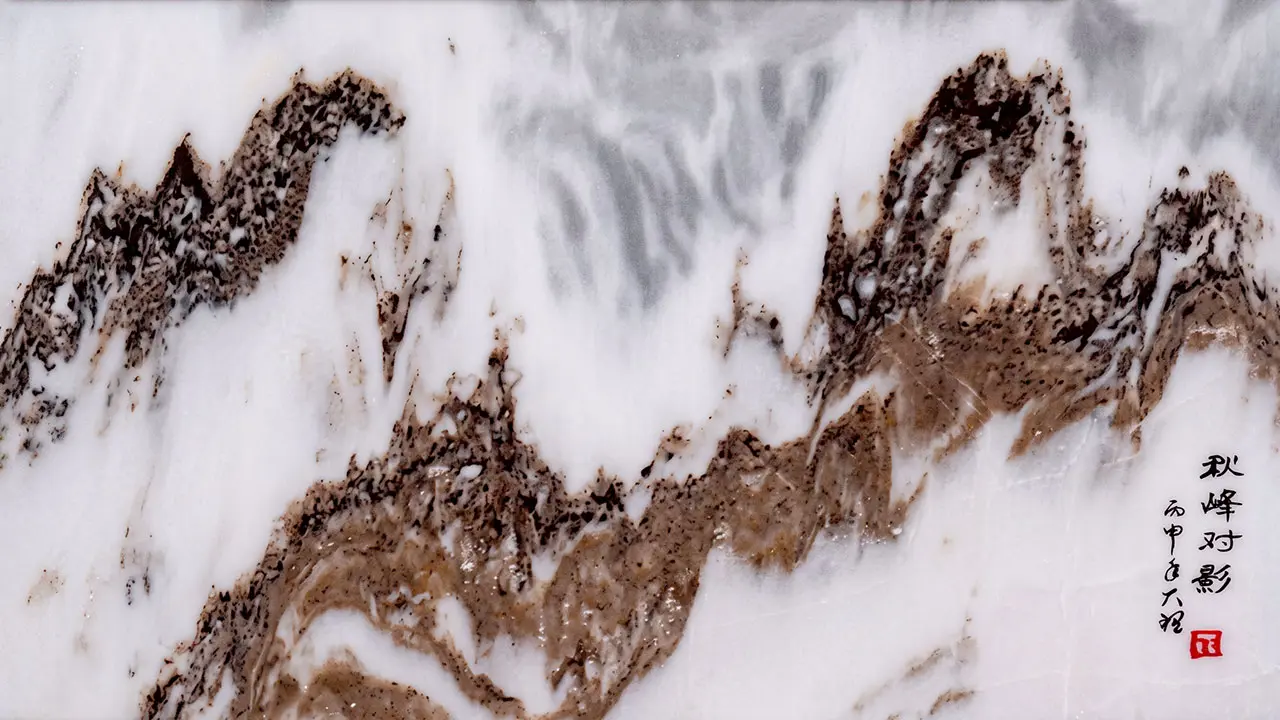
A natural marble picture is not painted onto the stone. A block quarried from Cangshan is cut and polished, and the exposed face gives up its veining: indigo, gray and white bleeding through one another into ridges, drifting cloud and riverbank. Not a single line has been drawn or carved by hand. Whether a picture emerges depends first on whether the stone holds a usable pattern, and then on where the saw is set - shift the cut a fraction and a possible landscape is lost. Small wonder that selecting and cutting the stone is sometimes compared to gambling. Whether a block deserves a place in a hall is often decided by that one cut.
Between Likeness and Unlikeness
The finest marble pictures live between likeness and unlikeness. Look long enough and it becomes a splashed-ink landscape, mist winding around cloud-wrapped peaks; turn it and the same stone resolves into fine-brush flowers and birds, or human figures and beasts. The whole repertoire of Chinese painting can be found in the grain, and the light and composition of Western painting too - inexhaustible in manner, endless in mood. Yet it is not a painting: no signature, no brushwork, only the texture left by hundreds of millions of years of geological change. Precisely because no one could produce its twin, scholars of every dynasty kept such slabs on their desks and looked at them again and again.
The Name "Stone Painting"
The scholar who gave the form its name was Ruan Yuan. While governor of Yunnan and Guizhou, he went repeatedly to Cangshan and concluded that the veins in the marble were "not the work of brush and ink, but the work of creation." He called them shihua - stone paintings. In 1840 he published Shihua ji, five volumes cataloguing nearly 300 marble screens from his own collection and those of friends, noting each slab's dimensions, describing the scene it seemed to hold, and composing verses for it in the manner used to catalogue paintings and calligraphy. Zhang Lunyuan wrote in his Wanshi zhai Dali shi pu that from then on "the name of Dali marble became widely known, and increasing numbers of pieces reached the interior." The stone walked from the foot of Cangshan into study rooms across China, and Ruan Yuan was the one who opened the way.
Beyond Wind, Flowers, Snow and Moon
What makes a marble picture precious is that it cannot be repeated. Its pattern is born with the stone: each picture is the only one of its kind, and no second will ever be made. It can be hung for pleasure or kept as a collector's piece - another calling card for Dali beyond "wind, flowers, snow and moon." Cangshan spent hundreds of millions of years pressing mountains, rivers and cloud shadows into stone; one cut of the saw, and out comes a landscape you can carry away.