

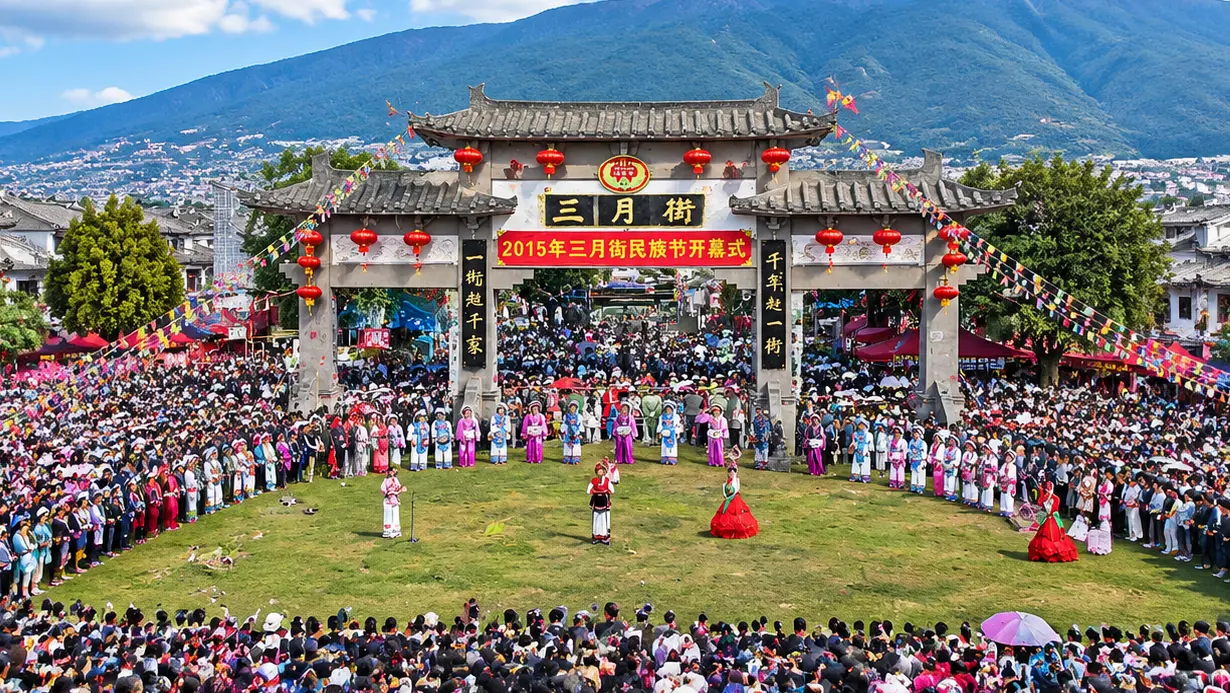
A Thousand Years on One Street
The Dali Third Month Street (San Yue Jie) festival, held every year from the 15th to the 22nd day of the third lunar month, is a traditional gathering with more than a thousand years of history for material and cultural exchange among the peoples of Dali. In ancient times it was also called the Guanyin fair or Guanyin festival. It is both the oldest and most flourishing trading fair of western Yunnan and the great annual festival of folk arts, sports, and mass exchange among all the peoples of Dali Prefecture. Since 1991 it has been fixed as a legal festival of the peoples of Dali Prefecture, uniting culture, sports, and trade on one stage; it begins every year on the 15th day of the third lunar month outside the West Gate of the Dali Old Town and lasts seven to ten days. In the early 1980s the State Council named Dali Old Town one of China's first 24 historically and culturally celebrated cities and one of its 44 famous scenic spots; in the early 1990s the prefecture government asked the provincial government to approve naming San Yue Jie the "Third Month Street Ethnic Festival of the Dali Bai Autonomous Prefecture." On June 7, 2008 the State Council approved its inclusion in the second batch of the national intangible cultural heritage list.
Folk Customs
During San Yue Jie, Dali closes for five days of holiday and guests pour in from everywhere, filling the streets to overflowing. Along the road running one kilometer from the West Gate of the Old Town toward the fairground, long awnings line up row after row and traders crowd in with dazzling goods, while throngs bargain at the stalls. The "street of famous local specialties" above all keeps visitors lingering: intricately carved Jianchuan woodwork, marbleware with gorgeous veining, Xiaguan tuo-cha tea, embroidered garments, and Dali straw hats draw crowds to stop and stare. The fairground also stages horse-racing, archery, wrestling, shooting, martial arts, chess, and ball games among the ethnic peoples, together with grand ethnic art performances, folk performance exchanges, dragon- and lion-dances, and the "king-rattle whip" dance.
Food and Trade
Snacks of every distinct local flavor make visitors reluctant to leave; they fall roughly into raw, cold, and cooked food. Famed Dali dishes include raw snails, raw pork ("shengpi"), "a palmful of snow," and clay-pot fish. Temporary eating-houses serving Bai three-course tea, clay-pot fish head, rusk fan (rushan), chicken stir-fried with sour papaya, beef braised with chestnuts, and huangmenji chicken are crowded with people from all over. Dali plums - sour, sweet, and salty - are also famous: sour-hot preserved plums salted with chili powder, stewed plums cooked with soaked broad beans, and carved plum-blossom "diaomei" that resemble artworks, cool and crisp on the tongue, their fragrance penetrating to the heart. As for trade: bulk medicinal materials from many provinces - pilose antler, musk, ginseng, chuanxiong, cordyceps, Gastrodia, fritillary bulbs, prepared aconite - make Dali Yunnan's largest medicines market; next comes the livestock trade, selling Burmese cattle, Inner Mongolian camels, and mules, horses, and oxen from across Yunnan, at more than ten thousand head per fair; then the native products of all Yunnan - tea from Fengqing and Pu'er, sugar from Jingdong, hams from Xuanwei and Heqing, gems, amber, and jade from Baoshan and Tengchong, Dali straw hats, tie-dye, and marble, Yangbi walnuts, Eryuan rushan and plums, Midu juan-ti pork, and Jianchuan woodcarving; and finally sundry goods for production and daily life.
History and the Legend
It is said that at the end of the Sui and beginning of the Tang, the demon Rakshasa occupied Dali; brutal by nature, it devoured thirty-six pairs of human eyes a day, and the people suffered beyond measure. In the Zhenguan reign of the Tang (627-649), the Bodhisattva Guanyin, come from the west, subdued Rakshasa. Fearing Rakshasa might return, Guanyin came to Dali each year from the 15th to the 22nd of the third lunar month to preach and expound the Dharma, and the faithful flocked in. Later, worrying that people attending year after year would fall behind in their farm work, Guanyin urged believers to bring farm produce to trade at the gathering, and so the periodic market - the jiezi - gradually took shape. Because it was held in the third lunar month, it became known as "Third Month Street." Guanyin's preaching is legend, but San Yue Jie itself has indeed survived a thousand years without fading.