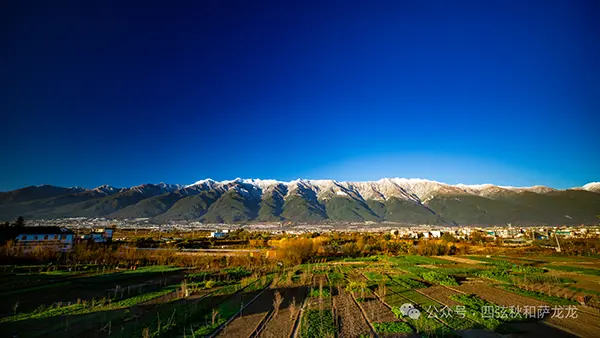

The Han: Dali is written onto the map
In the fourth and sixth years of the Yuanfeng era of the Western Han (107 and 105 BCE), the Han court twice campaigned against the "Kunming" tribes and then established four counties — Yeyu, Yunnan, Xielong and Bisu — in the Cangshan–Erhai region under Yizhou Commandery. From this point Dali was formally part of China. Archaeology and early records show that Bai ancestors' settlements reach back thousands of years earlier.
Tang & Song: the glory years of Nanzhao and the Dali Kingdom
In 738 CE (the 26th year of the Kaiyuan era), the Mengshe Zhao (Southern Zhao) absorbed the other five zhao with Tang support and unified the Erhai region, giving birth to the Nanzhao Kingdom, whose sway at its height covered present-day Yunnan, southern Sichuan, western Guizhou and even northern Burma, Laos and Vietnam. In 937, Duan Siping founded the Dali Kingdom with its capital at Dali City; Buddhism flourished so deeply that nine kings abdicated to become monks.
The two regimes, one continuous tradition, lasted more than five centuries in total and made Dali the political, economic and cultural center of the southwest. The Nanzhao Dehua Stele, the Shibao Mountain grottoes and the Three Pagodas of Chongsheng Temple are all footnotes left by this era.
Yuan, Ming & Qing: back to central rule under prefectures
In 1253, Kublai Khan led Mongol cavalry south to extinguish the Dali Kingdom, returning Dali to central rule — a Dali Route (lu) in the Yuan, then a Dali Prefecture (fu) in the Ming, carried on through the Qing. The old Dali city walls raised in the early Ming still show their checkerboard layout today.
The modern era: from commissioner's office to autonomous prefecture
- February 1, 1950: The Dali Commissioner's Office was founded, opening the era of people's government.
- 1956: The State Council approved abolishing the Dali Special District; on November 22, 1956, the Dali Bai Autonomous Prefecture was formally inaugurated, initially governing 1 city, 12 counties and 2 autonomous counties.
- 1983: Xiaguan City and Dali County merged into today's Dali City.
- 1985: Yangbi County became Yangbi Yi Autonomous County.
- 2019: The present structure took shape — 1 city, 8 counties and 3 autonomous counties: Dali City; the autonomous counties of Yangbi (Yi), Nanjian (Yi) and Weishan (Yi-Hui); and the eight counties of Xiangyun, Binchuan, Midu, Yongping, Yunlong, Eryuan, Jianchuan and Heqing, with the seat at Dali City.
From Han-dynasty counties to the autonomous prefecture of today, more than two millennia pass in a blink. Dali's administrative history is the liveliest illustration of how a frontier region merged with the Central Plains — from division to unity, from distance to closeness.