
Location
Dali Bai Autonomous Prefecture sits in west-central Yunnan Province, between 98°52′–101°03′ E and 24°41′–26°42′ N. It adjoins Chuxiong Prefecture to the east, Puer and Lincang to the south, Baoshan and Nujiang to the west, and Lijiang to the north. Its seat is Xiaguan in Dali City, about 331 km from Kunming.
The prefecture spans 29,459 km² — roughly 93.4% mountain and only 6.6% valley-basin land. It administers Dali City, the autonomous counties of Yangbi (Yi), Nanjian (Yi) and Weishan (Yi-Hui), and eight further counties (Xiangyun, Binchuan, Midu, Yongping, Yunlong, Eryuan, Jianchuan, Heqing) — twelve county-level units in all, with more than 110 townships. It is China's only Bai autonomous prefecture.
A modern portrait
- Population: 3.3376 million permanent residents at the 2020 census; about 3.34 million at the end of 2024, with an urbanization rate of 46.2%.
- Economy: GDP of ¥201.09 billion in 2024 (+2.5%); ¥208.75 billion in 2025, about ¥62,700 per capita, with a three-part structure near 20∶28∶52.
- Tourism: In 2024, Dali welcomed about 110 million visits with total tourism spending of ¥171.66 billion — tourism has become the prefecture's most important calling card.
A culture built over a millennium
Thousands of years ago, the ancestors of the Bai and Yi peoples were already living here. Dali entered the Qin Empire's map in 211 BCE and gained county government in the Han dynasty. During the Tang–Song era the Nanzhao Kingdom and the Dali Kingdom, centered on Erhai Lake, each dominated the region for roughly five centuries, making Dali the political, economic and cultural heart of Yunnan. Louis Cha's martial-arts novel The Demi-Gods and Semi-Devils and the 1960s film Five Golden Flowers put Dali on the global map.
Both Dali Old Town and Weishan Old Town are state-designated famous historical and cultural cities. Scattered across the Cangshan–Erhai region are the Three Pagodas of Chongsheng Temple, the Shibao Mountain grottoes, the Taihe City ruins and the Nanzhao Dehua Stele. The Bai "three-bay-and-one-screen-wall, four-courtyard-and-five-skylight" courtyard houses and the three-course tea of "bitter, sweet, then aftertaste" are culture's most recognizable symbols.
A natural palette of wind, flowers, snow and moon
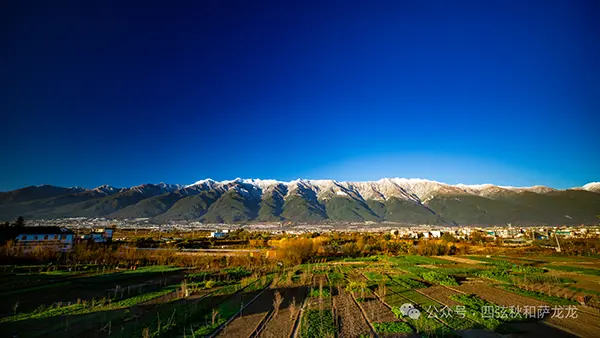
"Xiaguan wind, Shangguan flowers, Cangshan snow, Erhai moonlight" — four images capture Dali's natural beauty. The prefecture enjoys a low-latitude plateau monsoon climate: distinct wet and dry seasons, no scorching summers or bitter winters in most areas, small annual but large diurnal temperature swings. Elevations run from 730 m to 4,295.8 m; temperature drops roughly 0.6–0.7°C per 100 m of climb, so a single slope can span tropical, temperate and cold belts — hence "one mountain has four seasons, ten li of roads make different weather."
Average temperatures run 12–19°C with about 836 mm of rain a year (the May–October wet season carries 80%+ of the total) and a frost-free period of 225–345 days. Low latitude combined with high altitude offers a spring-like climate the year round.
A rich endowment
- Minerals: 20 metallic and 25 non-metallic minerals have been found; the Jinbaoshan platinum–palladium mine ranks second in China; Dali's marble is world-famous with proven reserves around 160 million m³.
- Hydropower: developable capacity reaches about 10 million kW.
- Produce: its biodiversity earns Dali the titles Home of Walnuts, Home of Plums, and Home of Dairy Cattle.
- Transport: the seat was historically a crossroads of the "Shu–Shendu (Sichuan–India) Road" and the Ancient Tea Horse Road; today it is the planned city center of western Yunnan, a regional transport hub and logistics center served by rail, highways and air — north to Sichuan–Tibet and beyond to India, south to Laos and Vietnam.