

A ritual turned celebration
Raosanlin ("winding around the three spirits") is a traditional Bai festival that fuses religious worship with a spring outing. In the Bai language it is called "Guan Sanlan" — "viewing the three sights." The "three spirits" are three sacred sites: the Buddhist Capital (Chongsheng Temple), the Deity Capital (the Benzhu temple at Qingdong), and the Immortal Capital (Erhe Shrine). Every year from the 23rd to the 25th of the fourth lunar month, tens of thousands of Bai people stream in from their villages to join a huge spring procession. It sets out from the City God Temple in Dali Old Town, passes through Chongsheng Temple, the Qingdong Benzhu Temple and the Erhe Shrine, and closes at the Benzhu Temple of Majiuyi village. At each stop, solemn rites and dancing celebrate the gods and delight the crowds, all in hope of good weather and peace. In June 2006, the State Council inscribed Raosanlin on the first national intangible-cultural-heritage list.
An encounter where status falls away
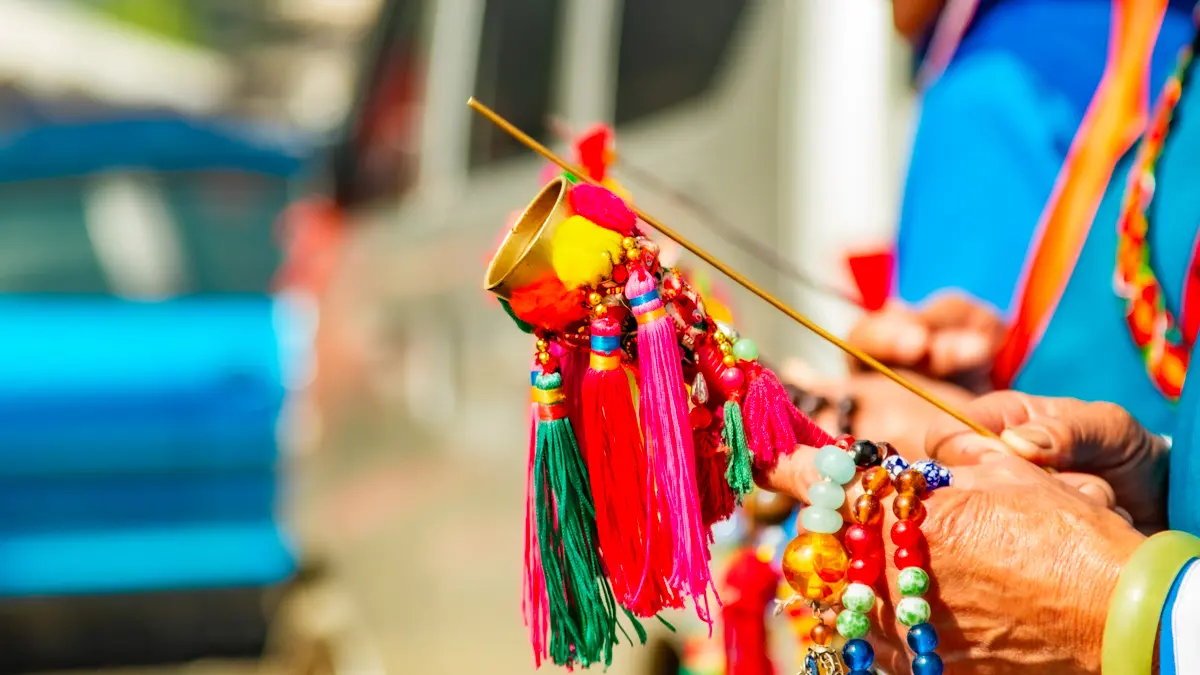
Raosanlin's signature is equality: participants of every rank, means and origin arrive in festive dress, hair threaded with flowers and faces bright with vermilion. Villagers march in village contingents. Each line is led by an elder man and an elder woman — the "flower-willow" singers — trading humorous Bai repartee in song. In the middle come men cracking wide sword-banners, ringing octagonal drums, or dancing the "double swallow." At the tail walks a whistler playing a leaf, behind him dozens of women singing and swaying while waving fans or straw hats. The whole column unrolls like a "one-armed serpent" across the Cangshan–Erhai country, horns and drums sounding, friends catching up, lovers stealing moments — a carnival that runs through the night.
In this open space where humans take each other freely, meet nature and touch the gods, the Bai's dance, antiphonal singing, Dabenqu narrative song, Dongjing ritual music, dress, food and crafts have been passed down and kept alive for generations.
A tradition kept by many hands
Since its 2006 listing, the prefecture's culture bureau and the Bai Studies Association have had heritage holders pool funds and seek government grants to clean up and formally protect the main venues. They also ran field surveys, built archives of images and of the inheritors. Carriers like the master Zhao Piding opened training classes and transmission halls to teach the performing skills, while communities and schools in Dali Town and Qingdong Village hold regular youth activities. Raosanlin thus keeps growing between Cangshan and Erhai — and lets more people glimpse the White people's distinctive cultural creativity.