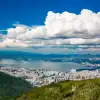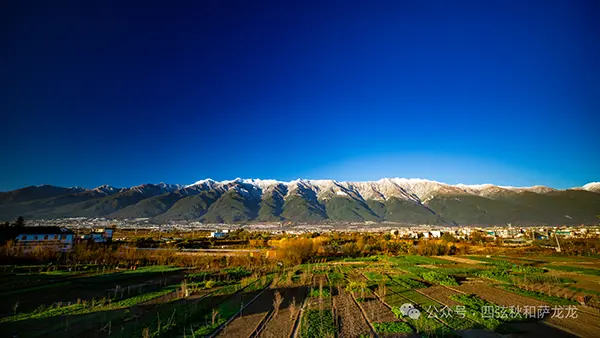

Land: a kingdom of mountains with fertile basins
Dali spans 29,459 km², with about 369,000 ha of cultivated land and 28,000 ha of orchards — a production base for citrus, apples, peaches, plums, pears, tea and mulberry. Land use runs roughly 60% forest, 20% pasture, 13% cropland and 7% other. Its soils fall into 8 orders, 13 great groups, 23 subgroups, 76 genera and 236 species; purple soil takes 31.75% and red earth 27.7% — together more than six in every ten parts.
Minerals: a rainbow of underground treasure
The prefecture's geology favors ore formation. Twenty metallic and twenty-five non-metallic minerals have been found across 200+ deposits and occurrences, more than 80 of them already worked (the Bei'an lead mine, the Heqing manganese mine, and the antimony mines of Weishan and Yangbi among them). Marble reserves are massive — a giant ore field and the very reason the name "Dali" (big marble/lï) reached households across China. The Jinbaoshan platinum–palladium mine is the country's second-largest platinum-group mine.
Water and power: flowing energy
Average annual precipitation reaches about 29.87 billion m³, and total water resources about 13.81 billion m³ — roughly 4,500 m³ per person, above the national average. More than 160 rivers hold 9.3 million kW of hydropower, of which 8.07 million kW is developable; barely 3.8% is tapped as yet. Geothermal springs line the Nanjian–Midu–Xiaguan–Eryuan belt — prime spots for a soak.
Biology: a natural gene bank
Dali is a living plant germplasm library: flora from the cold-temperate to the tropical margin, from the ancient and primitive to the newly evolved, all gather here. North and south split along a line through Mt. Jizu, Mt. Cangshan and Yunlong — temperate-cold flora in the north, subtropical in the south. Cangshan and Jizu unfold a complete vegetation ladder from base to summit. All six major vegetation types of the prefecture are present, with Yunnan pine, Armand pine, fir and hemlock clothing the slopes and ginkgo, yew, dove tree and lacebark fir hiding among them.
Dali runs five national forest parks (Weibaoshan, Qinghuadong, Dongshan, Lingbaoshan, Baotaishan), one national reserve (Cangshan–Erhai), three provincial reserves and fourteen prefecture-level ones. Cangshan alone hosts some 3,000 higher-plant species in 182 families and 927 genera. Dali is also a leading Yunnan medicinal-flora region — 600 traditional Chinese medicines are state-managed commodities here.
Beyond the raw endowment: turning landscape into a brand
Building on this ecological and climatic capital, Dali has tied tourism, sport and wellness together: hot-spring and hiking wellness products keep landing, and signature sporting events multiply. Among more than 130 scenic areas, one is 5A-rated (Chongsheng Temple & the Three Pagodas) and nine are 4A-rated. Cangshan became a national geopark in 2005 and a UNESCO Global Geopark on 23 September 2014.
The treasures go well beyond the Three Pagodas: the pagodas entered the first batch of national key protected cultural relics in 1961 — the main Qianxun Pagoda, 69.13 m tall, was built in the Nanzhao era, and the twin flanking pagodas were added under the Dali Kingdom. Dali Old Town's checkerboard layout boasts over 1,200 years of history; Xizhou preserves more than 15,000 Bai folk houses and is hailed as a treasury of Bai architecture. The prefecture holds 573 protected cultural-relic units, 114 traditional Chinese villages and 450 representative intangible-heritage items. The Bai opera Yucheng Shengmu took the top award at Yunnan's new-repertoire showcase, while Shu Xidiao won national arts funding and appeared at the 12th China Arts Festival.