
A town of carpenters on the Tea-Horse Road
Jianchuan lies in northwest Yunnan inside the Laojunshan zone — one of the eight districts of the "Three Parallel Rivers" World Heritage area — a thousand-year-old stronghold on the Yunnan–Tibet Tea-Horse Road and the county with China's highest share of Bai people. As early as the Tang dynasty, Jianchuan carpenters produced the wooden carved fittings of Nanzhao's Five-Flower Tower; in the Song, craftsmen earned fame performing in the capital. The Qing scholar Zhang Hong recorded in his Diannan Xinyu that across more than seventy Yunnan counties and the neighboring provinces of Sichuan, Guizhou and Guangxi, the able wielders of axe and chisel were "everywhere, all Jianchuan people." A Bai folk song celebrates the craft: "He carves a golden dragon dancing in the sky, chisels a golden rooster crowing the fifth watch, cuts out a hundred birds singing on the boughs — the carved flowers draw the bees."
From the Great Hall of the People to over a hundred countries
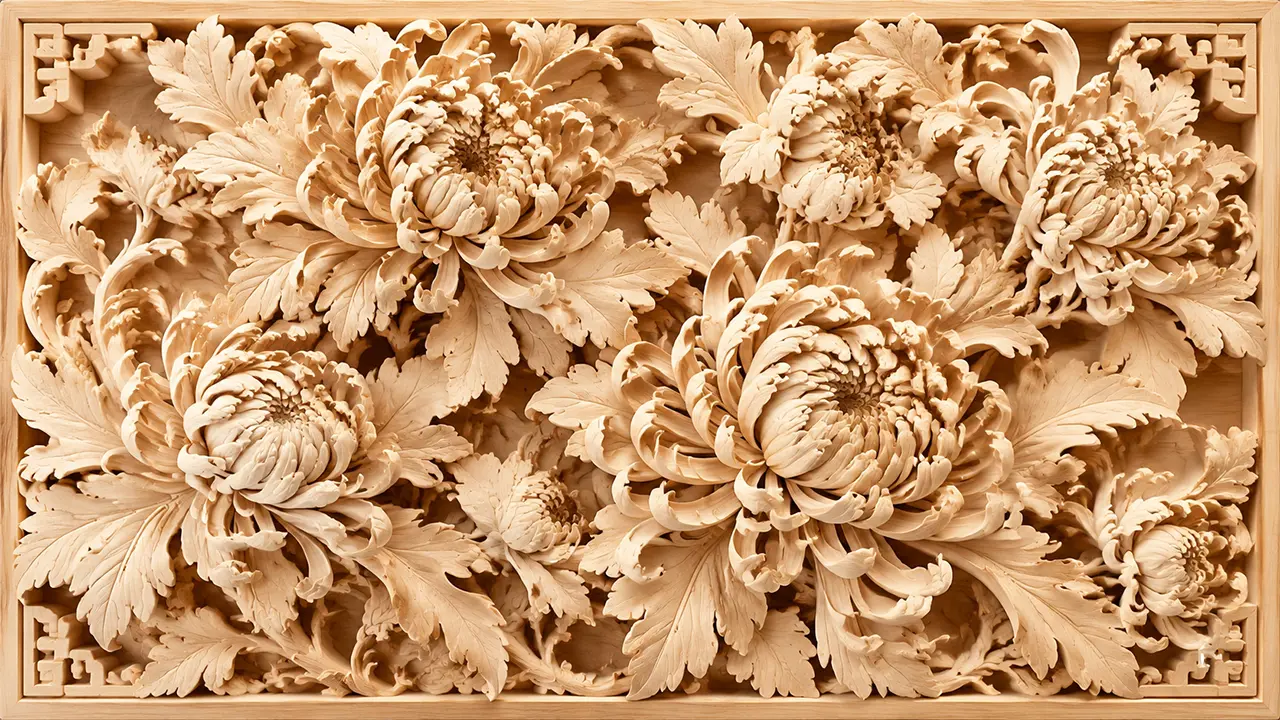
After 1949 Jianchuan wood carving boomed: the Great Hall of the People and the Cultural Palace of Nationalities in Beijing are adorned with it. Today the craft spans six lines — stone-inlaid carved furniture, wall panels and table screens, lattice doors, ancient architecture and interior decoration, tourist handicrafts, and modern furniture — covering more than 260 patterns that sell to over a hundred countries. Major works like Nanzhao Offertory Music and Dongba Murals have been rated first-class national handicrafts, and Shihe carving village is twinned with a Japanese craft village. Zhang Jinxing and Yang Songtian were recognized by UNESCO as folk arts masters. In 1996 the Ministry of Culture named Jianchuan "Hometown of Chinese Wood Carving Art," reconfirmed at the 2008 review.
A school that fused north and south
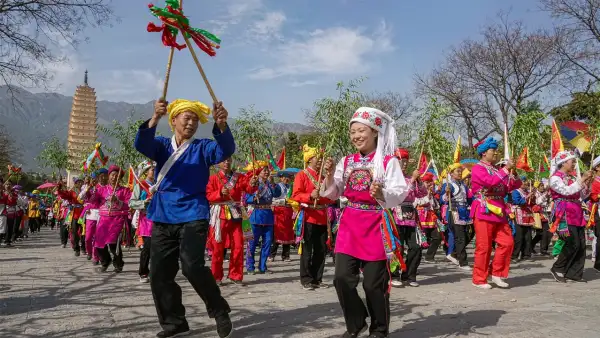
Jianchuan carving shows the Bai's artistic refinement while absorbing Central Plains influence — folding the bold vigor of local tradition into the delicacy and finesse of Jiangnan — making it a major school of national wood carving, coupled with Jianchuan's Shizhongshan grottoes (a first-batch national relic) as the "twin wonders of central Yunnan." The ground in which the craft grows remains fertile: the village still holds the "Lu Ban festival" on the eighth of the eighth lunar month and preserves China's richest trove of carpenter tales, ballads and narrative poems — precious material for ethnology, sociology, aesthetics and archaeology alike.